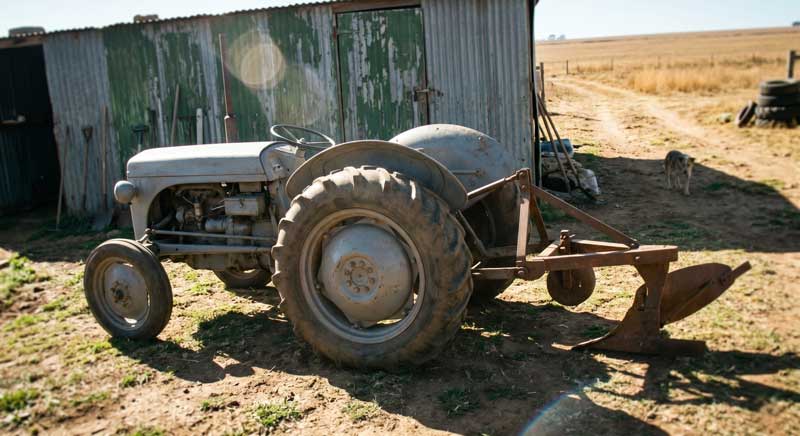
Walk onto almost any historic farm yard from the Western Cape to the Limpopo valley, and you are likely to spot a small, faded grey tractor resting in the corner of a shed or proudly displayed on a lawn. This is the Harry Ferguson TE20, a machine known universally in South Africa by its affectionate Afrikaans nickname: the Vaaljapie.
Meaning “little grey jack,” this diminutive tractor played an outsized role in modernising the country’s agricultural sector during the difficult years following the Second World War. Before its arrival, mechanical farming was largely reserved for massive estates operating heavy, dangerous, and expensive machinery. The Vaaljapie changed the countryside completely by making mechanisation accessible, affordable, and safe for the ordinary working farmer.
The Mechanical Secret: The Ferguson System
The true brilliance of the TE20 did not lie in raw engine power. In fact, the initial models produced a modest 20 horsepower from a small four-cylinder engine. Instead, its global and local success rested entirely on the innovative three-point linkage and hydraulic draft control system designed by Irish engineer Harry Ferguson.
Before this system, tractors simply towed implements from a low rear drawbar. This configuration carried a fatal flaw. If a heavy plough struck a buried rock, an old tree root, or thick clay in hard South African clay soils, the implement acted as a sudden anchor. The engine’s torque would force the tractor’s front wheels off the ground, frequently flipping the machine backward onto the operator in less than two seconds.
The Ferguson System solved this danger through mechanical intelligence:
- Integrated Implements: By connecting the implement to the tractor via three distinct linkage arms, the tool became an extension of the tractor frame.
- Automatic Draft Control: When a plough encountered an underground obstacle, the top link arm pushed forward against a heavy internal spring. This movement instantly directed the hydraulic pump to raise the lower links, lifting the implement just enough to clear the obstruction.
- Weight Transfer: Instead of lifting the front wheels, the draft forces were transferred downward through the rear tyres, increasing traction exactly when the tractor experienced a heavy mechanical load.
Post-War Arrival: Replacing the Ox Team
In the late 1940s, South African agriculture faced a transition period. Traditional spans of oxen and mules were slow, required dedicated grazing land, and could not cope with the intensive production demands of a growing post-war economy. The country needed an agile machine that was cheap to run and versatile enough to handle diverse tasks.
[ REPLACING THE ANIMAL TEAM ]
Traditional Span Vaaljapie TE20
- 14 to 16 Oxen - 20 Horsepower Engine
- Constant Grazing Land - Small Fuel Tank
- Slow Working Speed - High-Speed Field Travel
- Large Turning Circle - Tight Headland Turns
The Vaaljapie arrived at the perfect time. Its lightweight construction meant it did not compact delicate topsoil, an essential feature in the arid regions of the Karoo and the Western Cape fruit valleys. Furthermore, the adjustable front and rear tracks allowed farmers to alter the width of the wheels easily, adapting the tractor to match variable crop row widths without crushing the plants.
The Three Pillars of the South African Market
As imports grew, three main variations of the grey tractor became common on local farms, each tailored to specific fuel availabilities and operational preferences:
1. The TE-A 20 (Petrol)
Equipped with a standard Standard Motor Company petrol engine, this variant was favoured for its easy cold starting, smooth idling, and immediate power delivery during light utility work and transport tasks.
2. The TE-D 20 (Tractor Vaporising Oil)
By far the most common version in grain-producing regions, this dual-fuel model started on petrol and switched over to cheaper Tractor Vaporising Oil (TVO) once the manifold reached a high operating temperature. It provided a highly economical solution during post-war fuel shortages.
3. The TE-F 20 (Diesel)
Introduced in the early 1950s, this model featured an efficient compression-ignition diesel engine. It offered exceptional torque at low engine speeds and halved the hourly fuel bills of working farms, solidifying the transition to diesel power across the country.
A Canvas for Rural Ingenuity
Because the mechanical layout of the TE20 was beautifully simple and parts were completely standardised, local farmers quickly mastered its maintenance. In rural areas far from main urban centres, the Vaaljapie became a blank canvas for everyday engineering problem-solving.
Farmers modified the rear power take-off (PTO) to run lucerne cutters, drive deep-well irrigation pumps, power saw benches, and haul heavy wool bales over rough mountain passes. It became a reliable companion, deeply woven into the daily rhythm of rural life and community work.
Preserving the Grey Workhorse
Decades after the last TE20 rolled off the assembly line, the Vaaljapie remains an iconic symbol of resilience and mechanical simplicity. It taught a generation of South African operators how to transition away from animal draft teams and embrace modern farming methods safely. Today, maintained by active restoration enthusiasts and regional vintage clubs, these little grey machines continue to turn over with their distinct, crisp exhaust note—a living reminder of the engineering principles that helped build the foundations of local agriculture.