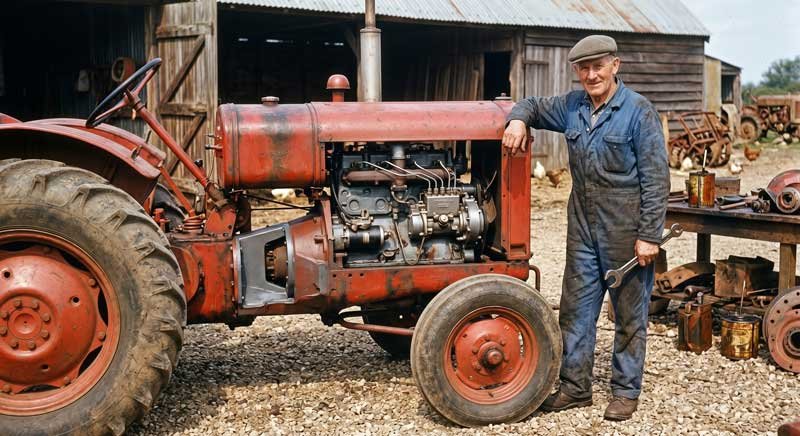
Squeezing Extra Life: The 1930s McCormick-Deering WK-40 and its Perkins L4 Drum Extension

During the agricultural expansion of the 1950s, South African farmers faced a tough practical dilemma. Massive pre-war tractors like the McCormick-Deering WK-40 possessed exceptionally tough gearboxes, heavy cast frames, and final drives that refused to break. However, their original large-capacity petrol-paraffin engines were becoming impossibly expensive to run.

As diesel became the undisputed king of farm efficiency, scrapping these structural steel-age giants felt like an absolute waste. The solution lay in a brilliant piece of post-war mechanical adaptation: stripping out the thirsty original powerplants and retrofitting compact, fuel-sipping British diesel engines using specialized engineering adaptations.

The Indestructible Backbone: The McCormick-Deering WK-40

Built by International Harvester in the late 1930s, the WK-40 was a high-power standard tractor designed for large-scale wheat farming and demanding belt-pulley operations. It was built with an abundance of cast iron and heavy-duty steel components, meaning the chassis and transmission outlasted the original internal combustion components by decades.

Despite the strength of the drive-line, the original engine had distinct disadvantages by the mid-20th century:

  • High Fuel Consumption: Running a massive four- or six-cylinder tractor on tractor vaporising oil (TVO) or petrol became financial madness compared to cheap diesel.
  • Maintenance Overhead: Sourcing original International Harvester engine parts in rural areas became increasingly difficult after the war.
  • Thermal Inefficiency: Paraffin engines required complex manifold heating setups and constant operator adjustment to avoid diluting the engine oil with unburnt fuel.

Enter the Perkins L4 Diesel

Launched by F. Perkins Ltd in 1952, the L4 diesel engine was a masterpiece of simple, reliable engineering. Producing around 48 horsepower, this four-cylinder diesel was specifically designed as a low-cost, high-torque power unit for agricultural and industrial applications.

The engine was a natural candidate to modernise older tractors. It offered instant cold starting, required far less maintenance, and halved the hourly fuel costs of a working tractor. However, dropping a compact British diesel into a massive American tractor frame built for a much larger engine block presented a massive physical gap.

The Mechanical Bridge: The Drum Extension Adapter

The greatest engineering challenge of this repower conversion was the structural distance between the back of the Perkins engine block and the forward face of the WK-40 transmission housing. The original American engine was significantly longer, meaning the clutch and input shaft configuration sat far deeper within the chassis frame.

To bridge this physical space without altering the structural integrity of the tractor’s frame channels, engineers and local engineering firms developed a specialized distance piece known as a clutch drum extension.

1. Structural Rigidity

The drum extension was a heavy, cylindrical cast-iron or machined steel spacer. It bolted directly to the rear flywheel housing of the Perkins L4 engine on one side, and mated perfectly with the original WK-40 bell housing on the other. This ensured that the engine and transmission remained a single, rigid structural unit capable of handling heavy twisting forces in the field.

2. Shaft Extension and Support

Because the Perkins flywheel sat too far forward, a specialized extended clutch shaft was fitted inside the drum extension. This shaft required a heavy-duty pilot bearing carrier mounted inside the centre of the spacer to prevent the extended shaft from whipping or flexing under sudden heavy loads.

3. Concentric Alignment

Precision was paramount. If the drum extension was out of true alignment by even a fraction of a millimetre, the resulting vibration would quickly destroy the rear main bearing of the Perkins engine or strip the splines on the WK-40 input shaft. Machinists had to carefully clock the adapter on a lathe, ensuring the mounting faces were perfectly parallel and concentric to the crankshaft centreline.

Field Impact: A Second Lease on Life

Once fitted with the Perkins L4 and its custom drum extension, the hybrid WK-40 became a unique operational beast. It combined the incredible weight, low centre of gravity, and massive traction of the 1930s chassis with the sharp, reliable torque and exceptional fuel economy of the 1950s diesel.

This specific modification allowed many South African farmers to squeeze an extra twenty to thirty years of hard service out of their pre-war investments. These converted machines spent decades clearing bush, pulling deep-suction ploughs, and driving stationary threshing machines, proving that clever mechanical adaptation can triumph over planned obsolescence.

Table of Contents